Showing posts with label Section 01: Who are you?. Show all posts

Section 1-1: The Myers-Briggs Type Indicator (MBTI)

 The Myers-Briggs Type Indicator is a practical application of psychological types first presented by Carl Jung in the 1920's and is currently used as a sort of classification system to sort people according to one of 16 different personality types. These personality types help to predict in a broad scope how an individual will behave in any given situation (though it ignores situational factors)  The MBTI system was developed in the 1940's by Isabel Myers-Briggs (Hence the name Myers-Briggs Type Indicator) and is used worldwide by millions for different applications.  Some examples of its application include: Introspection, Job applications or placements, career planning, psychiatric evaluations and many others as well.

For detailed information on MBTI visit the Myers & Briggs foundation
Myers & Briggs Foundation. (2003)

To Discover your own MBTI type (for personal use only. not a full evaluation) Click here!
HumanMetrics


Current logo for the MBTI Insturment
courtesy www.opp.com

Section 1-2: Peer Results of MBTI.

You ARE unique.. (or at least one in sixteen)
-Image courtesy of tumbr.com #barcode-

My class is a fairly small one, consisting of myself, 12 peers and one professor. There are 16 different personality types possible for MBTI. It is interesting that in our class then no two individuals had identical personalities. It is also interesting that when we were offered the choice to change our MBTI results according to our personal feelings in regards to the outcome of the test, only one individual chose to do so... is this reflective of their personality as well? I am aware that we are a small sample but surely our class is somewhat unique in this regard, which brings some interesting questions to mind.


-Are there certain types of personalities more dominant in a university setting?

-Are there certain types of personalities more dominant in society?

-Will the grades each student achieves be reflective of their personalities?

-Will the majority of the class get along or be at odds due to the uniqueness of each individual?


While I have yet to find exact answers to many of the questions written above, I have throughout the course gained enough knowledge to take educated guesses at the answers... they are as follows:


-No, a personality type may be more dominant in a specific field of study but there are enough different areas that each personality type will find a niche in some area of post-secondary studies.

-Because a part of who we are is influenced by external forces, and society as a whole tends to be heading towards a more extroverted locus, I believe certain types are becoming more frequent

-No, the amount of time and effort put into the coursework will reflect the grades, that being said, the ease at which each student applies said effort may vary greatly due to each personality type

-This belongs again in the hands of each individual and I do carry a small personal pride in the comradery that my peers have shown in no matter how small regard to one another.


Note to the Professor
I've been curious about this all semester and if you feel comfortable in sharing... what is YOUR MBTI result? and do you think your current career and/or hobbies fit in line with this classification? Or do you find that you oppose the typical description of your personal MBTI evaluation? (I am of course making the assumption that in your line of work that you have taken the full fledged examination for MBTI... and I am aware that this assumption is nothing more than just that. an assumption.)

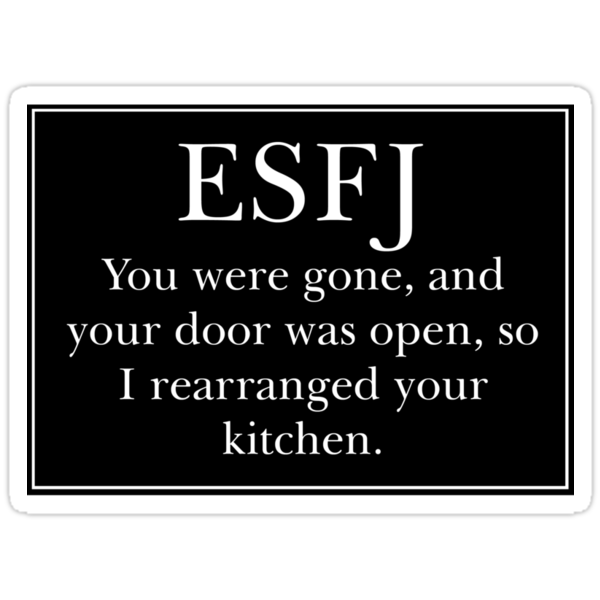

Section 1-3: Personal Results of MBTI

This is the last time I will mention this I promise, but this Journal assumes some prior knowledge of the topics discussed. If you are confused by the following, please take some time to review the Section overview and do your own research in the area.
Image courtesy redbubble.com


Yep. There it is. It's staring right at me. I get that this caption to the left is supposed to be a humorous over exaggeration of the "ESFJ" type.. yet If I was close enough to someone (say, a family member) I could see myself doing just that. While I will go on later to explain certain... grievances I have with two of the four letters on an individual basis. when you take the time and put them together like that, It's perfect. "Hits the nail on the head" to use metaphorical terms. I am the provider, and he is me.


Image courtesy thesixteentypes.tumblr.com
There is a handout we were given in class which describes the ESFJ as the "Hosts and Hostesses of the world" and more often than not this is true. I do often find myself playing the role of host even at events I am not hosting, most recent of which comes to mind is a close friends birthday party, in which I felt that I had to ensure the safety and bedding arrangements of all those present before I myself could rest. despite the fact that it was not my home, not my party. I felt it my duty to ensure everyone had a good time and got home safe.


Image courtesy thesixteentypes.tumblr.com
Even as a child I was the "goodie-two-shoes" the rule follower, and I yearned for structure and organization in my life. while I have learned in recent years to much better "roll with the punches" I still have an absurd amount of structure bordering on the OCD in my life (dresshirts arranged ROYGBIV, scheduled regular events such as dinnertime or garbage day.) even this secondary version of Journals is a good example of the lengths I will go to maintain structure. Even in my post secondary studies I aim for a typical ESFJ career. that of social work.

For more information on what it means to be an ESFJ...